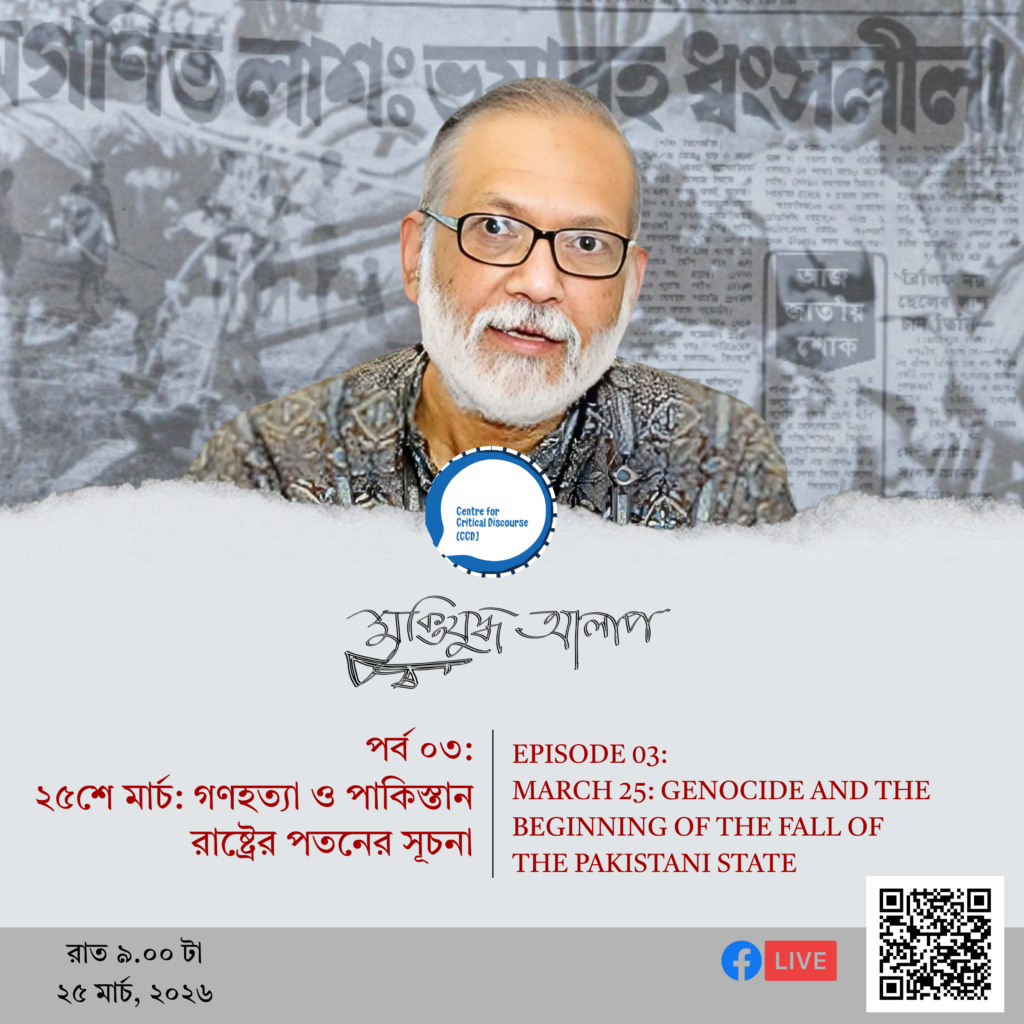
Historical archives show how historical narratives of the war are produced, curated and often instrumentalised to serve the dominant political parties’ ideological interests. “Muktijuddho-Alaap” is a critical consensus of collective resistance through narrative discourse. It claims back counter-hegemonic discourses of the silenced women, peasants, workers, subalterns, and the alternative history of politics during the liberation war.
This session examined the political backgrounds and geopolitical dimensions of the different forces active during the Liberation War, featuring Altaf Parvez as discussant. It highlighted how diverse groups pursued distinct strategies shaped by their ideological positions, from the Mujib Bahini emerging from the nationalist thought relying on Indian support, to Maoist left groups conducting independent guerrilla warfare rooted in mass mobilisation. The discussion contextualised the rise of the ‘Nucleus’ and Mujib Bahini within broader communist movements, contrasting nationalist interpretations of inequality with class-based analyses advanced by leftist factions. It also explored the roles of pro-Moscow and pro-Peking communist groups, their ideological divisions, and their differing approaches to revolution and electoral politics. The session further reflected on figures like Siraj Sikder, whose early call for independence and efforts to build alternative resistance movements offered a parallel trajectory to mainstream forces. It concluded by questioning the marginalisation of such contributions in dominant narratives and emphasised the need to analyse the Liberation War within a broader, multi-dimensional political and geopolitical framework.